There's a strange pattern: the shorter the business trip, the harder it is to pack. For just a few days, we somehow want to take everything — as if preparing to live several different lives: one outfit for a meeting, another just in case, something for dinner, something in case it turns cool, one more dress, because we might suddenly want to look different.
As a result, the suitcase gets heavier, but the problem remains. The pieces are there, but putting together an outfit from them is a separate task.
A business trip calls for a different approach: not shrinking the wardrobe down to a few pieces for the sake of minimalism itself, but packing it so that each piece plays more than one role.


Before opening the closet, it's worth looking not at the number of days, but at what will actually happen during the trip: travel, work meetings, dinner, a free morning, a walk around the city, and perhaps one more meeting that calls for a slightly different level of formality.
One day may call for two or three outfits, while another needs only one. That's why it's better to make the list of items after the list of scenarios. This quickly makes clear what's truly needed, and what we're packing only because of an anxious "just in case."


A Capsule Is Not About Minimalism
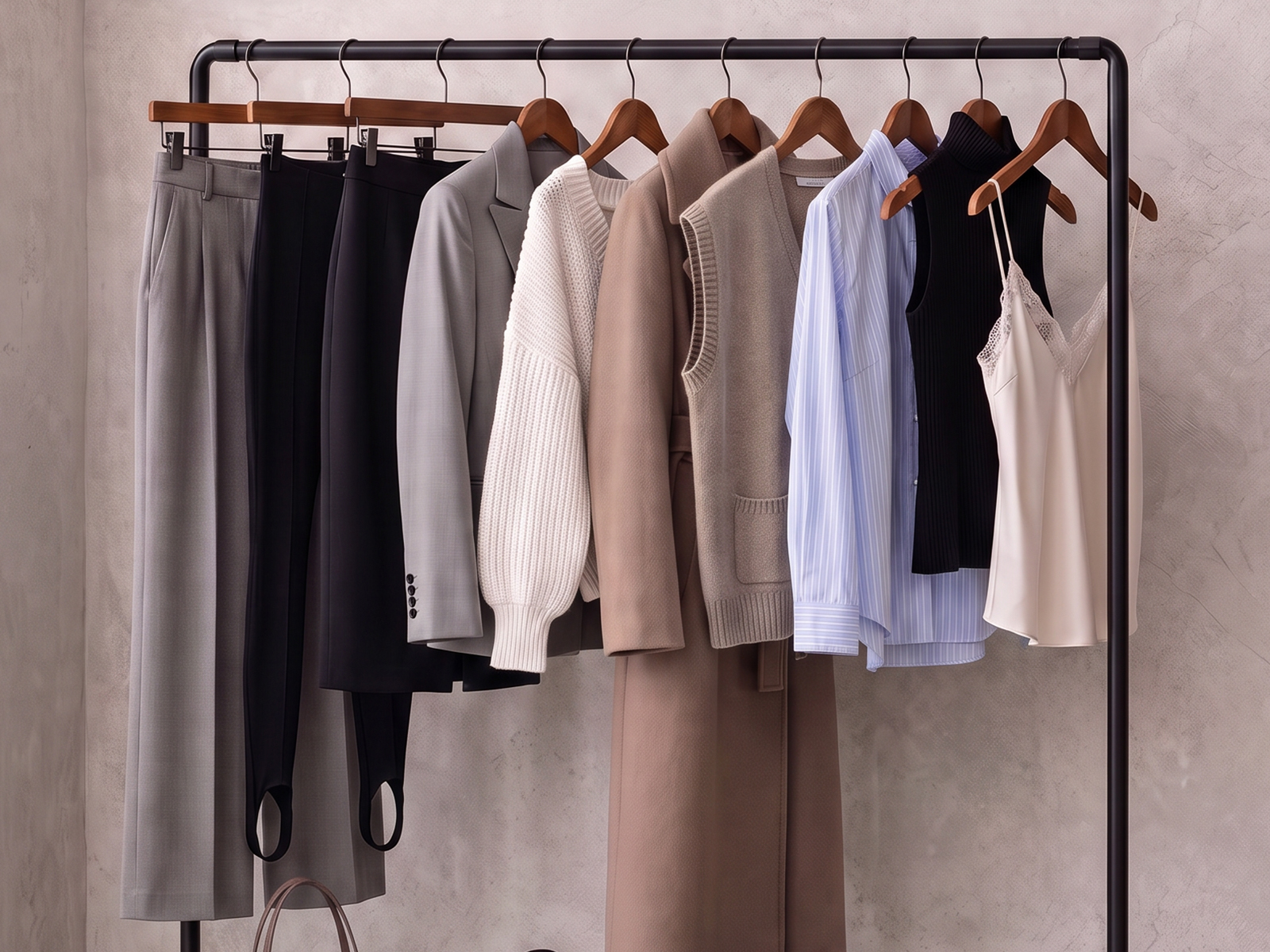
For a short business trip, Natali Bolgar stylist Anastasia recommends sticking to a simple base: 2–3 bottoms, 3–4 tops, a jacket, and one versatile dress.
That's enough to put together 8–10 or more outfits, as long as the pieces combine well with each other. Pants should work not just with one shirt, but with several tops. A skirt shouldn't require a special set. A dress can stand as an outfit on its own, or it can change character depending on the shoes, jacket, or accessories.
By the way, the idea of a capsule wardrobe itself is much older than today's fashion for minimalism. In the 1970s, London boutique owner Susie Faux of Wardrobe used the term capsule wardrobe for a small edit of basic pieces that could be worn in different combinations and topped up with seasonal ones. The concept later found new life through designers, but its essence stayed the same: fewer pieces shouldn't mean fewer options.
That's exactly why, before a trip, it's useful to ask yourself a simple question: how many different outfits can I put together from each piece?


Why a Neutral Palette Really Makes Life Easier
In a suitcase, black, off-white, beige, grey, navy, and other calm shades work especially well. Not because neutral colors are automatically better, but because they let pieces combine easily and don't make you start an outfit from scratch every morning.
When the base of the wardrobe is built in a similar mood palette, the same jacket can be worn with different bottoms, and a shirt can be paired with both pants and a skirt. One accent is entirely appropriate here: a favorite shirt shade, a silk scarf, jewelry, or shoes.
This works especially well on a business trip, when there's usually no time for long deliberation in front of the mirror.


One Jacket, Several Roles
In a suitcase like this, a jacket works as one of the wardrobe's key pieces. With it, pants take on a more business-like character, jeans look more put-together, and worn over a dress, it easily turns a daytime outfit into an evening one.
The only thing that matters is that the jacket itself is versatile enough: not too demanding to care for, comfortable to move in, and just as appropriate buttoned as unbuttoned. Then it truly works throughout the whole trip, instead of taking up space for the sake of a single outfit.
The same principle applies to tops. A shirt changes the character of the same bottom, knitwear adds softness, and a T-shirt makes the outfit more relaxed.


Shoes Shouldn't Need Their Own Suitcase
Two pairs are usually enough: one for travel and an active day, the other more elegant, for meetings and evenings.
But there's an important nuance here: both pairs need to work with most of the pieces in the suitcase. If a pair of shoes only suits one outfit, it's already taking up too much space — even if it's physically a small pair.
The same goes for a bag. One compact style that looks right both at a meeting and at dinner in the evening is often more useful than two or three "for different occasions."


Accessories Don't Change the Wardrobe, They Change Its Tone
A belt, glasses, jewelry, a silk scarf — details that take up almost no space but help the same outfit avoid looking identical every day.
Pieces are responsible for the wardrobe's structure, accessories — for changing its tone.
So instead of one more dress, it's sometimes smarter to pack a scarf. Instead of a second "evening" piece — jewelry that will transform an outfit you already know.


Fabric Has to Survive the Business Trip Too
On a trip, fabric goes through its own test: hours in transit, sitting, a suitcase, a hotel, a rushed morning, and back into the suitcase.
That's why knitwear, suiting fabrics, denim, and dense viscose are especially practical for business trips — materials that hold their shape well, don't need constant ironing, and handle travel without trouble.
Because the best fabric for a business trip isn't the one with the nicest description on the label, but the one that, after hours in a suitcase, doesn't send you looking for an iron.


And Most Important — Don't Pack an Imaginary Life
The most space in a suitcase is often taken up not by pieces, but by scenarios that are unlikely to happen.
If you don't know whether there will be a restaurant, it's better to skip a separate "restaurant" outfit and instead pack a piece you can turn into an evening look with shoes, jewelry, or a jacket. If the forecast promises cool weather, you don't necessarily need to pack a whole extra set — first, it's worth thinking about what you can layer from what's already in the suitcase.
Behind this "just in case" is a perfectly understandable psychology: we feel that more options mean more freedom. In reality, an excess of choice can, on the contrary, make deciding harder. A study by Sheena Iyengar and Mark Lepper back in 2000 showed that in a number of situations, people chose more readily and were more satisfied with their decision when they had fewer options, not more.
That's why a well-packed suitcase works not just with space, but with your attention. The fewer unnecessary decisions you have to make in the morning, the more energy is left for the trip itself.
A good test for every piece is simple: what else would I wear it with? If the answer is nothing, it probably doesn't belong in this suitcase.
And if what's ahead isn't a business trip but an ordinary trip, the logic is the same — only the scenarios will differ. We wrote about this in more detail in the article "A Travel Capsule: Seven Pieces for Ten-Plus Outfits in a Carry-On".


Before You Close the Suitcase
Check yourself not by the number of pieces, but by the number of situations they help cover.
- Is there an outfit for travel?
- Are there several options for work meetings?
- Can the same jacket or pants be used in another outfit?
- Do the shoes work with most of the pieces?
- Is there something for the evening without a separate "evening wardrobe"?
- Will all the pieces survive the trip well?
- Did you pack something only because it "might come in handy"?
And one more good trick: once everything is packed, remove one piece. Not the most important one — just the one without which the system won't fall apart.
On a business trip, what works well isn't a wardrobe with an answer for every possible situation, but one where a single piece can be the answer to several of them.
So a successful suitcase should really be judged not by how much it holds, but by how much freedom it leaves you once you've closed it.