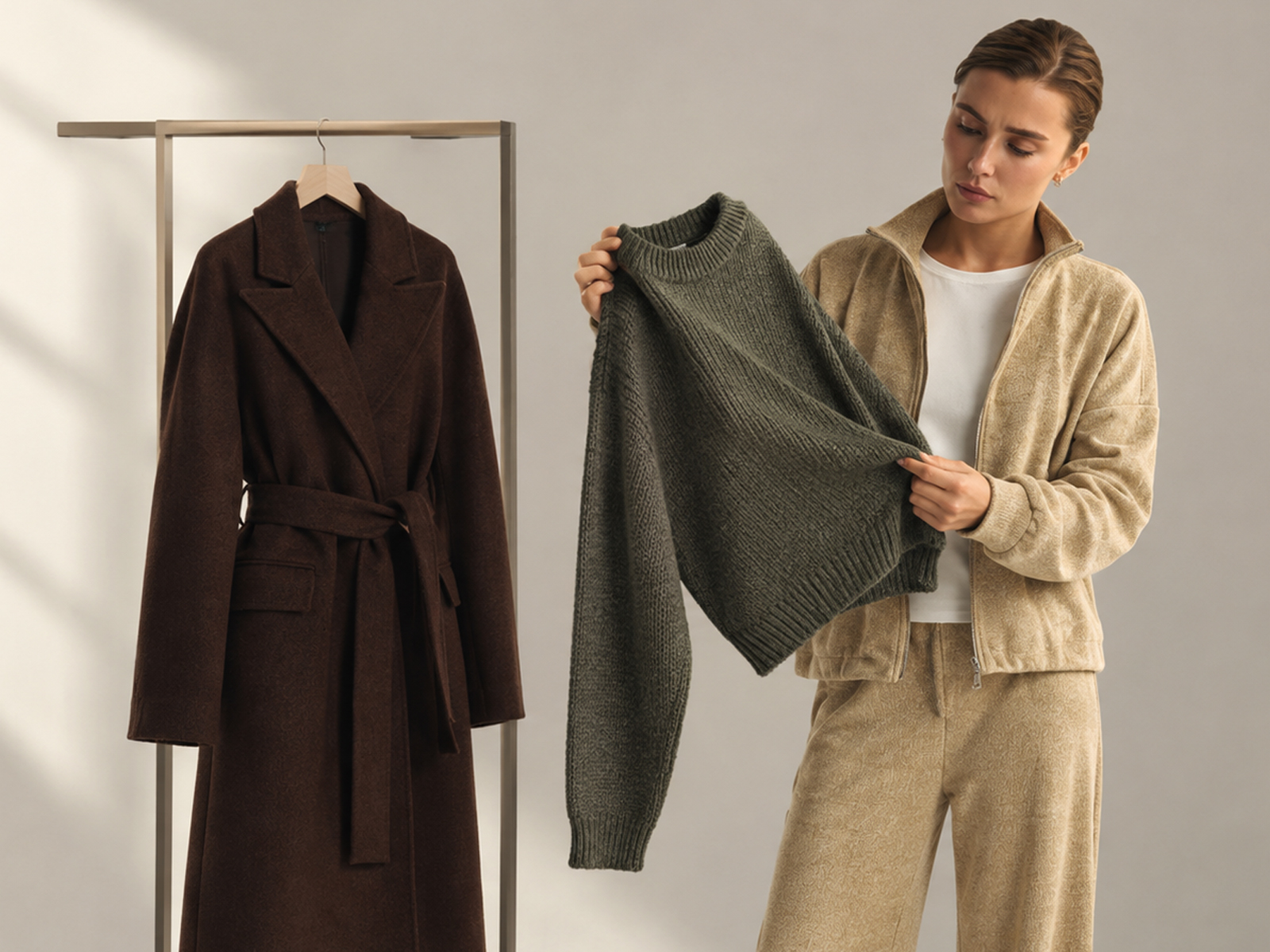
Almost every one of us has opened a closet at least once with the thought: "I have nothing to wear", even though the shelves are barely closing.
The paradox is that the problem is almost never the number of pieces. It's the number of decisions we've been postponing for years: "I'll lose weight eventually", "It was expensive", "My mother gave me this", "Fashion is cyclical. It'll come in handy again".
We think we're storing clothes, but what we're actually storing are stories. That's exactly why a wardrobe detox doesn't start with the closet. It starts with the decision to stop living in yesterday's wardrobe.


A good wardrobe works on the same principle as a museum exhibition
The world's major museums hold hundreds of thousands of pieces. But visitors see only a small part of the collection.
Not because the rest is less valuable. But because the curator always asks one question: "Why does this particular piece need to be here today?"
A wardrobe works the same way. Don't ask whether a dress is good. Ask yourself: does it have a place in my life right now?
Once you look at it this way, a detox stops being a fight against clutter. It becomes a mindful selection of what actually works for you.


A wardrobe detox in six steps
Step 1. An honest look at your wardrobe
Don't try to take stock by just peering into the closet. Take everything out.
Natali Bolgar stylist Anastasia recommends sorting pieces into categories right away: jackets, dresses, trousers, skirts, knitwear, shirts, outerwear.
Only then does it become obvious how many identical pieces have piled up, what's duplicated, and which basics, on the other hand, are missing.
A practical tip: don't rush to judge pieces right away. First, just look at the wardrobe as a whole. Very often that overall picture tells you more than individual try-ons do.


Step 2. Separate facts from emotions
During a review, it's easy to ask: "Do I like it or not?"
It's far more useful to ask yourself other questions:
— Have I worn this piece within the last year?
— Does it fit my current lifestyle?
— Does it pair easily with at least three other pieces?
— Do I feel confident in it?
If there are almost no "yes" answers, the issue may not be the piece itself anymore.
Anastasia points to one more important thing: don't keep a piece just because it once cost a lot. Past spending isn't a reason for a piece to keep taking up space in your wardrobe today.


Step 3. See not what's excess, but what already works
After the review, most people immediately think about what to get rid of. A stylist looks at it differently. She first looks for the foundation of the wardrobe: the pieces you reach for almost automatically, that pair easily with everything else, and that you come back to again and again. The wardrobe is built around those.
We've actually already covered this in detail in the article "How Much Clothing a Woman Really Needs: Wardrobe Math". Its main idea is simple: a wardrobe works not thanks to the number of pieces, but thanks to the number of connections between them. Sometimes one well-cut jacket or a versatile pair of trousers creates more outfits than ten random purchases.
And this is exactly where the most surprising part comes in. People think a wardrobe detox will leave them with fewer pieces in the closet. In reality, a good detox leaves you with more outfits.
A practical tip: set aside five to seven pieces you reach for most often. These are the foundation of your wardrobe. Everything else should work alongside them, not exist on its own.


Step 4. Identify what's missing
Only now does it make sense to think about new purchases, not before. Once the excess is gone, the gaps become obvious.
Maybe you have plenty of knitwear but no one quality jacket to tie half your wardrobe together. Or plenty of blouses but not enough versatile trousers.
That's exactly why a wardrobe detox is almost always more useful than impulse shopping. It helps you buy not more, but more precisely.
A practical tip: write down the pieces you truly lack, but don't rush to buy them the same day. After a few days it'll become clear whether it's a real need or just a wish to fill the emptiness.


Step 5. Don't rush to fill the empty space
An empty shelf very quickly triggers the urge to fill it with something. That's exactly the moment when it's easy to fall back into old habits.
Natali Bolgar stylist Anastasia recommends asking yourself just one question before every new purchase: "Will this piece become part of at least five outfits I'll actually wear?"
It's a simple test, but it filters out impulse purchases very quickly. If the answer feels uncertain, give yourself a little time. The best decisions rarely need to be rushed.


Step 6. Leave room for the life you're living today
A wardrobe doesn't need rebuilding every season. Revisiting it twice a year with fresh eyes is enough to keep it a living system rather than an archive of random purchases.
At Natali Bolgar, we often talk not about the number of pieces, but about their ability to last and to pair with one another. It's around pieces like these that a wardrobe naturally takes shape over time — one that doesn't require a constant urge to start from scratch.
And perhaps that's the most valuable thing after any wardrobe detox: not perfect order, not empty shelves, but the sense that every piece is there for a reason.
Because a good wardrobe isn't the one with fewer pieces. It's the one that no longer leaves you second-guessing your choices every morning.