We tend to think of math as always being about addition.
One more shirt, one more dress, one more pair of shoes — but a wardrobe works the other way around.
Sometimes the problem isn't that you own too little. The problem is that what you own simply hasn't learned to work together.


Why we count clothes at all
The word garde-robe comes to us from Old French. Originally it didn't mean a closet in the modern sense, but a separate room where clothing, fabrics, and personal belongings were kept. Even then, a wardrobe wasn't a random pile of purchases but a deliberate construction: every piece had its place, its purpose, and a natural affinity with the others.
Centuries have passed. There's far more clothing now. But the question remains the same: how many pieces are enough?
The answer was probably never a number.


A wardrobe isn't a warehouse
There's an interesting pattern here. Two women can own the exact same number of pieces. One gets dressed in a few minutes. The other stands in front of an open closet every morning, for far too long.
The difference isn't the quantity. The difference is how the pieces interact with each other.
We're used to judging a wardrobe vertically: how many dresses, shirts, or pairs of shoes it contains.
In reality, it deserves a different lens. Not how many pieces you own, but how many combinations they're capable of creating. That's exactly why one well-considered shirt can end up more valuable than three random ones.


One piece should live several lives
A good wardrobe never operates on a "one piece, one look" basis.
The same shirt can be part of an office suit on Monday, a second layer over a cami on a day off, paired with jeans on the weekend, or with a skirt in the evening.
The same goes for a jacket, trousers, or a simple dress. Their true value isn't that they're beautiful on their own. It's that a single piece unlocks dozens of new combinations.
That's exactly why we so often talk not about individual pieces, but about a wardrobe as a construction kit.
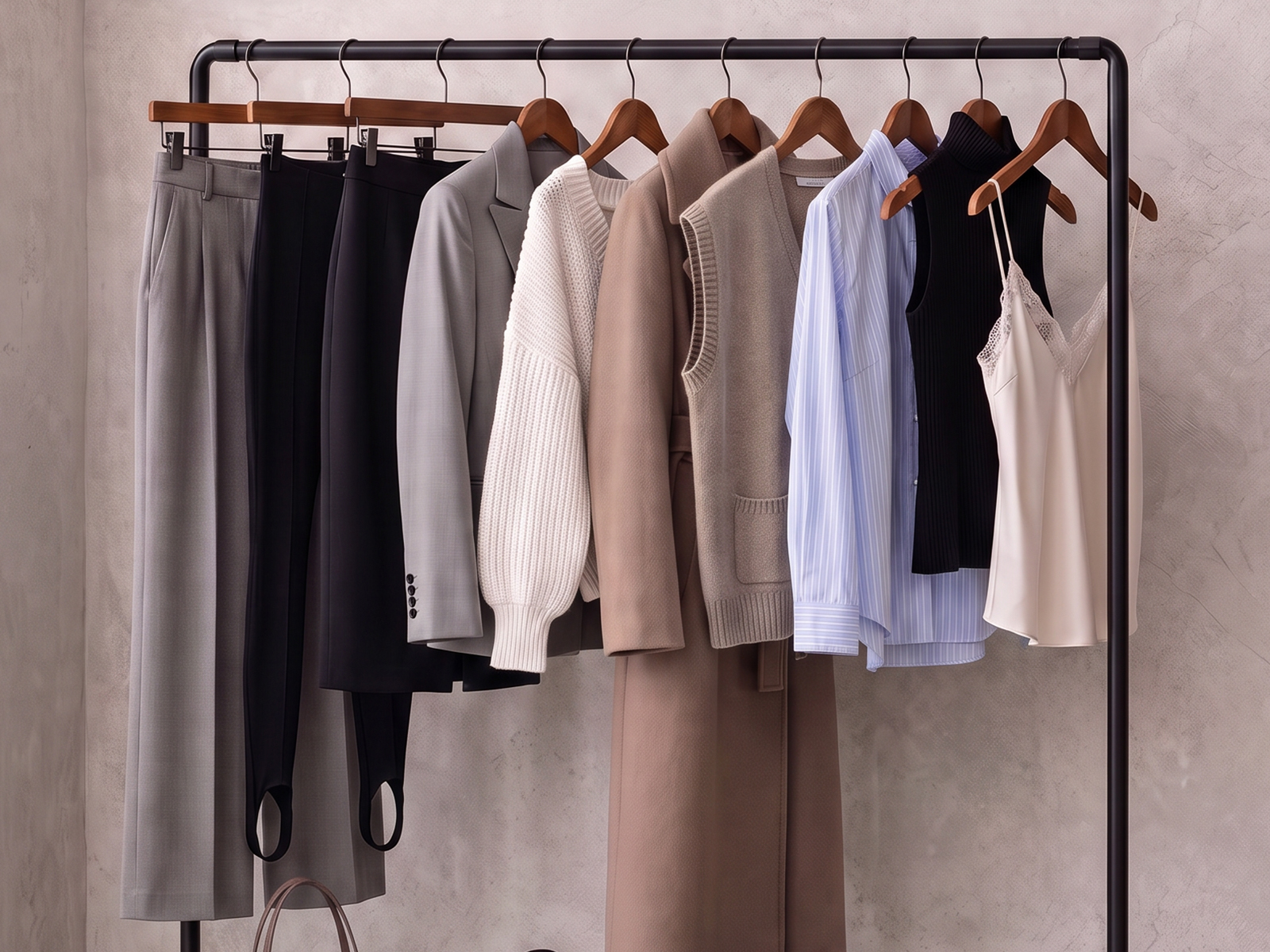
We've already written about how seven pieces can create dozens of looks from morning to evening. Not because seven is a magic number, but because even a small set starts working entirely differently once the pieces are combined with intention.
A wardrobe becomes more valuable not when it has more pieces, but when there are more connections between them.


Don't buy closet space. Buy possibilities
There's a simple question worth asking yourself before every new purchase.
What in my existing wardrobe will this piece actually pair with?
If the answer is just one outfit, maybe the issue isn't that you need a new piece. Maybe you need a different one — one that opens up not one but ten new options.
That's exactly why stylists talk about "the basics" so often. But it's not that basic pieces have to be "correct." They become the anchor point for the entire wardrobe.
A good jacket doesn't exist in isolation. It works with trousers, jeans, a dress, or a skirt. In the same way, a silk shirt or a simple skirt isn't limited to one outfit — it starts generating new ones.
That's exactly why a piece's value isn't defined by its price. It's defined by how many new looks it lets you build.


Every woman has her own formula
There is no universal formula.
The wardrobe of a woman who works in an office every day will never look like the wardrobe of a designer who works remotely. In the same way, the life of a young mother calls for entirely different needs than the life of someone who travels for work on a regular basis.
That's exactly why we love looking for ready-made answers so much.
How many dresses do you need? How many pairs of shoes are enough? How many jackets should be in the closet?
The right question sounds different: does my wardrobe match my life?
Because life is always the best stylist there is.


Five principles that work almost every time
A perfect formula doesn't exist, but there are principles that help make a wardrobe more cohesive.
Don't count pieces — count combinations. Before buying, ask yourself: how many things in my closet will this already work with?
You usually need more tops than bottoms. A single pair of pants or a single skirt can be the foundation for dozens of looks. It's usually the top that changes their character.
Every new piece should open up new possibilities. If a purchase only works for itself, it barely works for the wardrobe.
Your wardrobe should reflect your life, not someone else's. Not Pinterest, not Instagram, not your favorite blogger's closet. Your own pace of life always matters more than any trend.
Before you buy, ask yourself three questions: Does this piece fit my lifestyle? Can it create at least three new combinations? Will I still want to wear it not just this season, but years from now?


When a wardrobe starts working for you
There's a mistake every one of us has made at least once.
We've bought a beautiful piece not because we needed it, but simply because we loved it.
There's nothing wrong with that. The problem shows up when too many pieces like that pile up.
Then your closet turns into a collection of separate stories that never intersect with each other. And the wardrobe starts demanding new purchases just to "rescue" the previous ones.
Even though what it actually needs isn't another piece. It needs logic.
That's exactly why Natali Bolgar collections are built like a construction kit. We think not only about a single dress or jacket, but about how it will interact with the pieces already in a woman's wardrobe. So that a new purchase doesn't demand an entirely new outfit, but naturally becomes part of one.
A wardrobe comes together gradually — through good decisions, thoughtful purchases, and pieces that support one another.
And perhaps that's exactly where its real math lies. Not in how many pieces hang in the closet. But in how many possibilities they create together.
Because a good wardrobe isn't one with too few pieces. Nor is it one with too many. It's one where every piece knows its place.