

Some suits look wonderful in September but lose their point by November. The fabric turns out to be too light, the jacket lacks room for knitwear, and adding one more layer changes the silhouette.
That is why an autumn-winter suit is worth judging not only by how it looks on its own. What matters more is what happens when the temperature drops, a sweater appears under the jacket, and a coat goes on top.


In brief
- Fabric for the cold season matters not only for its composition: density, texture, drape, and the ability to hold shape all count.
- The lining affects how the jacket moves with the body and how it sits over a shirt or knitwear.
- The first layer changes the character of the suit: a shirt keeps it classic, a turtleneck or jumper makes it softer.
- The fit of the jacket is worth checking with the very layer you plan to wear in autumn and winter.
- A suit doesn't have to be worn as a set: the jacket and trousers should work separately if you want more outfits from them.
- Color is best judged together with the future layers—knitwear, coat, shoes, and accessories.
- A good suit for the cold season doesn't get in the way of layering; it helps organize it.


From Chanel to Schiaparelli: how the women's suit learned to change
The history of the women's suit is interesting because its classics were never something frozen. The suit itself stayed recognizable, but ideas about comfort, strength, and femininity kept changing.
Gabrielle Chanel was one of the first to bet on what seems obvious today: clothes should not just fit well but let a woman move. In the 1920s she worked actively with jersey, a material previously associated mostly with men's underwear and sportswear. Her suits were softer than the traditional women's jacket, had a freer construction, and did not require the body to stay still for the sake of a beautiful silhouette.
Elsa Schiaparelli offered a different answer. In the Autumn/Winter 1931–32 collection “Wooden Soldiers,” she emphasized the shoulders, narrowed the waist, and turned the jacket into almost an architectural construction. Shoulder pads and a strong shoulder line became not just details of cut but a way to change the very geometry of the female silhouette. This approach later had a major influence on 1930s fashion and Hollywood costume.
Between Chanel's soft jersey and Schiaparelli's strong shoulder lies a whole story about what a women's suit can be. And perhaps the most interesting part is that both ideas still work: a jacket can be structured but not rigid; relaxed but not shapeless.
That is why a good suit doesn't necessarily dictate what your figure should be. It negotiates with it.


Fabric for the cold season: why composition is not the only criterion
A label can tell you how much wool, viscose, or synthetic fiber a fabric contains. But it won't tell you how this fabric will behave on you.
One fabric holds its shape almost architecturally, another moves softly with the body. One stands up well to a long day on the move, another loses its look faster. And even two fabrics with the same composition can feel completely different.
So it's worth looking beyond the numbers. Density, surface, drape, and the ability to recover shape after movement often say more about a suit's future than the composition in percentages.
There is also a simple test: squeeze a small area of fabric in your hand, release it, and see how it returns to its original state. Run your palm over the surface. Sit down in the jacket. Move your arms. Suiting fabric is quite eloquent if you give it the chance to “answer.”
Nor should an autumn-winter suit automatically be reduced to a wool one. Wool works wonderfully in the cold season, but a warm suiting fabric can have different compositions. What matters more is how it behaves in this particular construction and in the conditions where you plan to wear it.
By the way, a wool suit doesn't have to go to the dry cleaner after every wear. Sometimes it needs much simpler things: airing, rest between wears, and a soft brush that removes dust from the surface of the fabric. This is the basic care Woolmark recommends for woven wool garments; the method of washing or dry cleaning is always determined by the care label of the specific item.


Lining: what it changes in the fit of a jacket
The lining is one of those details you remember only when it works badly.
In autumn and winter this is especially noticeable: under the jacket there is no longer just a shirt but a long-sleeve top, a turtleneck, or a thin jumper. The extra layer adds volume, and the construction of the jacket has to allow for it.
The lining is best noticed not when you see it, but when you stop feeling it. It should help the jacket move with the body, not create extra tension, and not get in the way of the first layer.
And the best place to check all this is not in theory but in the fitting room.


What to wear under a jacket in autumn and winter?
The first layer can change the character of a suit more than a new bag or a pair of shoes. Sometimes it's enough to swap a shirt for a turtleneck, and the same jacket starts speaking a completely different language.
A shirt keeps the outfit polished and classic. It works well where a clean vertical line is needed.
A turtleneck takes away some of the office strictness and looks especially good with jackets that have a strong shoulder line.
A thin jumper adds softness. Thickness matters here: if the knit creates extra volume under the sleeves, the jacket will show it quickly.
A long-sleeve top is a simple way to make a suit more casual.
A knit polo is interesting for its in-between character: the collar supports the structure of the jacket, while the soft texture makes the outfit less formal.
A thin cardigan, buttoned up as a top, is another option for cool weather. It adds a layer without overloading the silhouette.
A thick sweater under a classic jacket, on the other hand, is a question not so much of style as of construction. If this is your favorite scenario, it's better to look right away for a model with enough room in the shoulders, armholes, and sleeves.


How to try on a jacket with a winter first layer?
In the fitting room, a jacket can look flawless. But a few movements will quickly show how practical that flawlessness is.
So if you are buying it for the cold season, it's worth trying it on right away with the layer you will wear most often: a turtleneck, a thin jumper, a long-sleeve top, or a cardigan.
Raise your arms, bend your elbows, sit down, walk around. Look at the shoulders, armholes, and sleeves. If the back starts to pull, the sleeve becomes too tight, and the lapels or fronts lose their line, this is no longer a question of styling. The construction simply lacks room for the way you plan to wear it.
The mirror shows the silhouette. Movement shows the construction.


Should a suit work separately from the set?
When buying a suit, it's easy to picture just one ready-made outfit: jacket plus trousers. But this is exactly where you can miss half of its potential.
The jacket can work with jeans, or with straight or wide trousers in a different texture. The suit trousers can work with a shirt, thin knitwear, a waistcoat, or a sweater.
So before buying, it helps to ask yourself two questions: what will I wear this jacket with on its own? What will I wear these trousers with?
If the answers come without long thought, the suit already works not as a single outfit but as a small system.


How to choose a suit color for layered outfits?
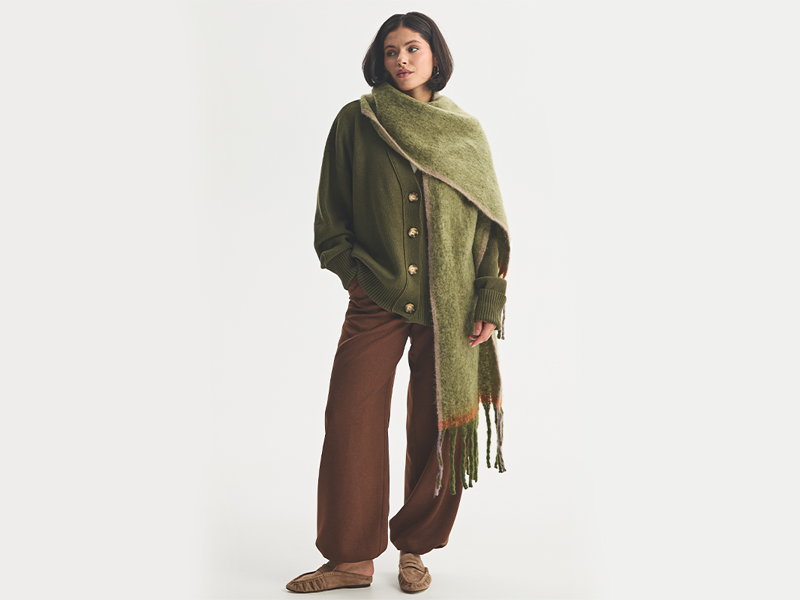
An autumn-winter suit almost never stays alone with you. Knitwear goes under it, a coat goes over it, and shoes, a bag, and a scarf are nearby. So color is better judged not in isolation but in the company of future pieces.
Graphite, navy, chocolate, and beige combine easily with different layers. But that doesn't mean the suit has to be neutral.
A saturated color can also work as a staple, if you give it enough calm space around it. Then it doesn't become an “accent piece for one night out” but gets a much longer life.


A suit should work across several temperature ranges
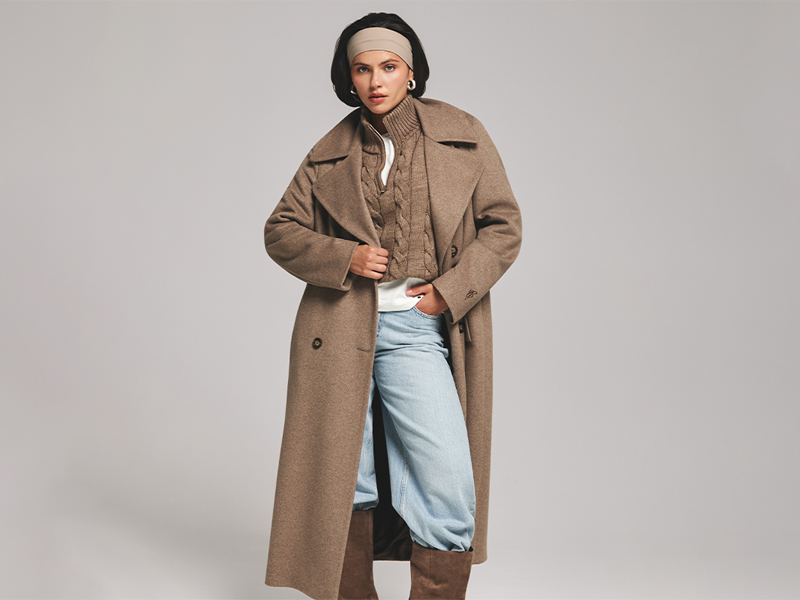
In September a jacket can be the top layer. In October thin knitwear appears under it, and a coat goes on top. By November the same suit becomes part of a full layered construction.
In a wardrobe, an autumn-winter suit holds an interesting place: it is no longer a first layer, but not yet outerwear. That is why it has special requirements.
If you want to understand layering in more detail, we have already written about it in the article “Layering for beginners: 5 rules so you don't look bulkier”.
But the main principle is simple: a good jacket shouldn't make you choose between style and warmth every time. It should leave enough room to add or remove layers depending on the weather.


Frequently asked questions about a suit in autumn and winter
Which fabric is best for an autumn-winter suit?
There is no single universal composition. Density, texture, drape, the fabric's ability to hold its shape, and comfort in movement all matter.
What to wear under a classic jacket in winter?
A shirt, a thin turtleneck, a long-sleeve top, a thin jumper, a knit polo, or a thin cardigan worn as a top. If you want to wear a thicker sweater under the jacket, choose a model with matching room in the shoulders, armholes, and sleeves.
Can you wear a sweater under a classic jacket?
Yes, if the construction of the jacket allows for an extra layer. The simplest test is to try it on with the very sweater you plan to wear.
How can you tell that a suit is right for the cold season?
Judge not only the fabric composition but also its density, texture, fit, and how the jacket behaves over the first layer.
Is it worth buying a suit if I don't plan to wear it as a set?
Yes, if both pieces have their own scenarios. The jacket can work with other trousers, and the suit trousers with knitwear, shirts, or waistcoats.
A good autumn-winter suit doesn't have to be the warmest piece in your closet. Its job is different: to give you enough room to add layers, change the character of an outfit, and avoid rebuilding your whole wardrobe every time the temperature drops a few degrees.
In the end, true classics are not pieces that look good in one unchanging form. They are pieces that know how to stay relevant when everything around them changes.