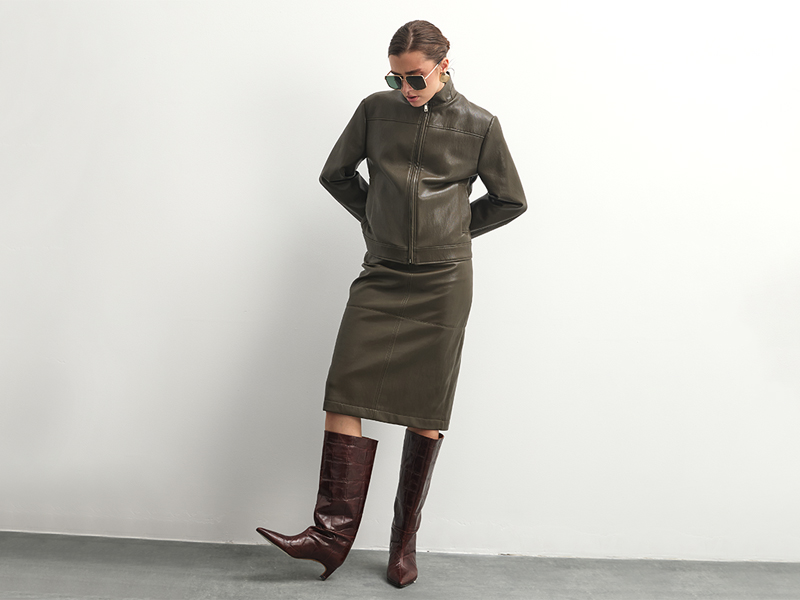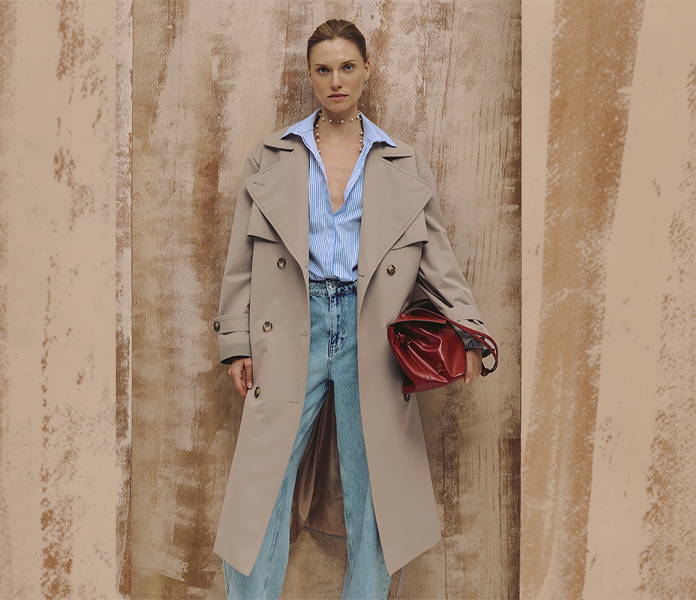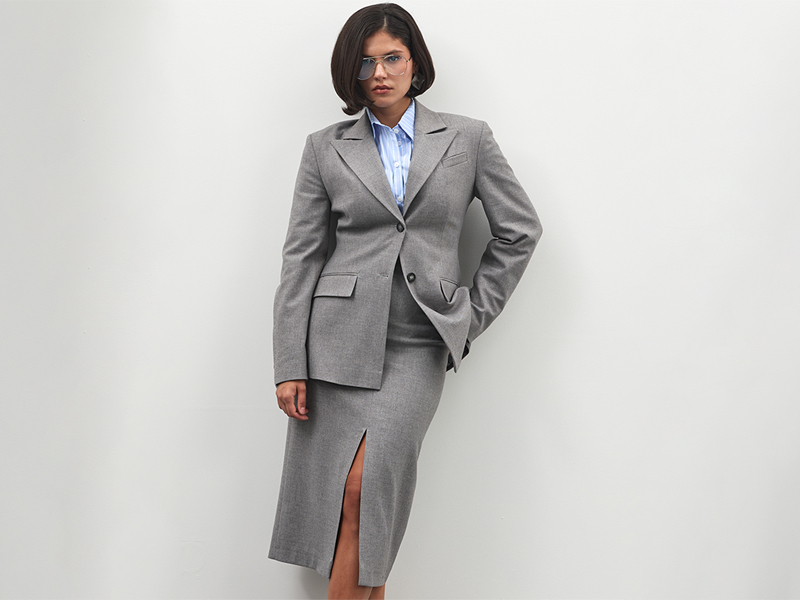


Some outfits with three layers look lighter than one. And sometimes it's the opposite: adding a sweater over a shirt is enough to suddenly make the silhouette heavier. It's not about the number of pieces. It's about where the volume appears, how its lines meet, and what's left between them.
That's why layering isn't just a way to stay warm in autumn. It's a way to control shape.
We're used to thinking of it as a modern styling trick, though the idea itself is far older than any trend. For centuries, clothing was built in layers for entirely practical reasons: a single piece couldn't protect against cold, wind, or bad weather while staying comfortable in different conditions. The bottom layer could be removed, the top one added, and the air left between them worked for warmth too.
But gradually, a practical system turned into an aesthetic one. What mattered became not just what was worn, but which layer peeked out from under another, where one piece ended and the next began, how several different textures formed a single shape.
That's how layering became a language of its own. And once you know a few basic rules, it stops being a game of "what else should I put on?" and starts working for the silhouette.


1. Define the main volume
Layering usually adds visual weight not because there are too many pieces. It's just that all of them try to add volume at the same time.
An oversized sweater over a shirt, a wide jacket, and a loose-fit coat on top. Add wide trousers, and pieces that looked convincing on their own suddenly start competing with each other.
So the first rule is simple: one layer should define the shape, the others should support it.
If the outfit's main piece is a large sweater, the first layer underneath can be thin and close to the body. If the focus is on a structured jacket, there's no need to create another large volume underneath.
This doesn't mean layering requires a narrow bottom or fitted clothing. It requires hierarchy.
Volume on its own doesn't make a silhouette heavier. What adds weight is the lack of difference between volumes.


2. Play with length
When several layers end at roughly the same height, the silhouette breaks into horizontal lines. This is especially noticeable when a shirt, a sweater, and a jacket almost match each other in length.
It's far more interesting when there's a difference between them.
A short jacket can reveal the layer underneath. The edge of a shirt can peek out from under a sweater. A long vest can create a vertical line between the outerwear and the bottom.
And it's not necessary to show the whole layer. Sometimes just a few centimeters of fabric do more for the composition than an entire extra piece.
In good layering, length doesn't just add another line. It sets the rhythm of the silhouette.


3. Distribute volume, don't accumulate it
There's a difference between a large silhouette and a silhouette where all the volume ends up in one place.
For example, a large sweater, a full skirt, and a long, wide coat create one solid mass. Not because any of the pieces is "wrong." Each one simply adds roughly the same thing — width.
So the next layer sometimes needs to add not volume, but structure or movement.
A wide sweater can work with straight trousers. A structured jacket — with soft knitwear. A long coat — with a more compact first layer.
This isn't the "wide on top, narrow on the bottom" formula. Fashion moved past that mathematical exercise long ago.
It's about something else: the eye needs to understand where the mass is concentrated in the outfit, and where space begins.


4. Add verticals
An unbuttoned jacket, a long vest, an open shirt, a coat left unfastened, even a long scarf — all of these create vertical lines that change how a layered outfit is perceived.
When the top layer is open, the eye moves from top to bottom instead of pausing at every horizontal line between pieces.
This works especially well in autumn, when outerwear becomes a big part of the outfit. A jacket can stay open under a coat. A shirt — open over thin knitwear. A long scarf can extend the coat's line.
But there's a limit here too. There's no need to turn yourself into a collection of vertical stripes. One expressive line is often enough.


5. Leave air between the layers
This rule is the easiest one to miss, because it's about what's almost invisible in the outfit.
Layering doesn't require showing every piece in full. A collar can just peek out from under a sweater. Cuffs — from a jacket's sleeves. The edge of a shirt — a few centimeters below.
Sometimes a layer is only noticeable when you move. It's exactly these small gaps that keep layering from turning into one solid mass of fabric. They create pauses between shapes.
Good layering leaves room not just for clothing, but for the air between it.


How to check your outfit before you leave
There are three simple tests that work especially well for layering.
Step away from the mirror.
Up close, we see the collar, texture, buttons, cuffs. From a distance, what's left is the silhouette. If it reads calmly, the construction works.
Look at yourself in profile.
It's from the side that you can clearly see where the real volume has formed, and where it was added by a random combination of pieces.
Take off the top layer.
If a self-sufficient outfit remains under the coat or jacket, you haven't just added clothing — you've created a system. If everything relies only on the last piece, it's worth taking one step back.
And one more question worth asking before you leave: what do I want to see first in this outfit?
If the answer is "everything," then you probably already have enough layers.


What about the fall-winter wardrobe?
In the cold season, layering feels especially natural, because it lets you adjust the outfit as the temperature changes. Thin knitwear under a jacket, a shirt under a sweater, a vest between the first layer and a coat — the same pieces can work differently depending on the combination.
In the Natali Bolgar collection, this principle comes through clearly in combining pieces of different weights: thin layers can be worn under jackets and outerwear, while knitwear pairs with tailored pieces and other layers without overloading the silhouette.
What matters here is not just adding one more piece, but understanding what it changes in the outfit: whether it adds warmth, creates a new line, shifts the proportion, or simply makes the combination more interesting.


Layering doesn't start with a third piece
You can spend years building a wardrobe and still look at it as a set of separate items: a sweater here, a jacket there, a coat somewhere else. Or you can start seeing the connections between them one day.
What happens if you wear a thin turtleneck instead of a shirt under this jacket? If you leave the coat unbuttoned? If you change the length of the bottom layer by a few centimeters? If you remove one piece instead of adding another?
This is where layering stops being just a technique for getting dressed. It becomes a way of looking at your own wardrobe.
And once you start seeing not separate pieces, but a system of how they combine, another question naturally comes up — what exactly is your system? We already wrote about this in the article "How to find your personal style if no trend appeals to you".
Because style doesn't start with the number of layers. It starts the moment you understand why each one is there.