A business conference is a space where representatives of different companies and industries meet, new professional connections form, and public talks and negotiations take place. Within a single day, you can find yourself in an audience of hundreds, end up in the organizers' photos, appear on camera during a livestream, or join a conversation with potential partners. So a business outfit here has to suit not only the format of the event, but also the different situations its attendee may find herself in.
In winter, there is one more dimension: the season changes not only the choice of materials, but the very logic of styling. You want to keep a clean silhouette, avoid overloading the outfit with layers, and still look appropriate in a professional setting. At the same time, a modern business wardrobe allows far more freedom with textures, colors, and proportions than was customary before.
So let's look at how to prepare your wardrobe for a winter business conference or forum: define the right level of formality, choose a suit and fabrics, plan your layering, outerwear, shoes, and the details that will work for your outfit all day long.


In brief
-Start from the format of the event. A business forum, a trade exhibition, and a conference with an evening reception can call for different levels of formality.
-Pay attention to how the clothes are made. In a winter wardrobe, warmth and fabric composition matter, but so does how a piece holds its shape and works with other layers.
-Choose fabrics with the environment in mind. The fabric should keep its shape and stay comfortable both on the way there and through a many-hour program indoors.
-Think through the details for your role. An attendee, a speaker, and a moderator may each need to consider different styling nuances.


How to gauge the formality level of a business conference
Before choosing specific pieces, it helps to understand the professional environment of the event. A financial forum, a legal conference, a tech summit, and a creative business meetup can have completely different atmospheres. Where a business suit traditionally dominates, an overly relaxed outfit can look out of place. At a tech or creative industry event, on the other hand, a strictly formal look can sometimes feel excessive.
The simplest guide is the information from the organizers. If the invitation says Business Formal, Business Professional, or Business Casual, that already points the way. If no dress code is specified, look at the program, the list of attendees, the venue, and photos from previous events. It is also worth considering your own role: an attendee who goes to lectures and chats during breaks is not always expected to be as formal as a speaker or a company representative.
By the way, we have already covered how cultural context shapes business dress rules in "Dress Code for International Business Meetings: Clothing Etiquette Across Cultures". In this article, we'll focus on a different aspect — the specifics of a business wardrobe in the cold season.


The business suit: the foundation of a winter outfit
The suit remains one of the most expressive choices for a business conference. It gives the outfit a clear structure, helps you work with proportions, and needs no complicated styling to look polished. For winter, trouser suits in dense fabrics, skirt sets, and jackets that can be paired with separate pieces are especially relevant.
It is important to look not only at the cut but also at the construction. The shoulder line, the fit of the jacket, the sleeve length, the width of the trouser legs, and the way the fabric falls in motion shape the overall impression no less than color does. If you plan to wear a thin jumper or a vest under the jacket, account for the extra layer right away: clothes should not restrict movement or add bulk at the armholes and shoulders.
In this context, it is worth recalling one of the most original takes on the business suit in fashion history. In 1936, Elsa Schiaparelli collaborated with Salvador Dalí on a design known as the Bureau Suit, or the suit with drawer pockets. On a navy velvet outfit, she placed pockets that resembled the pull-out drawers of a writing desk, while plastic buttons imitated their handles. The idea came from Dalí's surrealist imagery, in particular his drawings of anthropomorphic furniture. Photographer Cecil Beaton shot the suit for Vogue, turning it into one of the best-known examples of a creative dialogue between fashion and art.
This episode is interesting for more than its unusual design. It is a reminder that a business suit does not have to be without character. Its expressiveness can come through the cut, texture, proportions, or one unexpected detail — without losing coherence or appropriateness.


Fabrics and textures: what to choose for the cold season
In winter, the material becomes one of the main factors in comfort. For a business wardrobe, look at wool and blended suiting fabrics: they help retain warmth while supporting the shape of the garment. Jersey works just as well — a pliable material that adapts to movement and makes it possible to create suits with a softer silhouette. Tweed and other warm, textured fabrics give outfits more character thanks to their weave and surface.
Wool, notably, has natural properties that are especially useful when temperatures change. Its fibers can absorb water vapor and gradually release moisture, while their crimped structure traps air and helps retain heat. That is why a quality wool piece can be comfortable not only in the cold, but also during long hours indoors.
For the base layer, thin jumpers, turtlenecks, and knitwear in merino wool or other soft fibers work well. They add no extra bulk under a jacket and let you adjust the outfit to the temperature. If the conference means a long day in a well-heated space, don't choose an overly warm outfit based only on the weather outside: it should be comfortable indoors as well.


Layering without the bulk
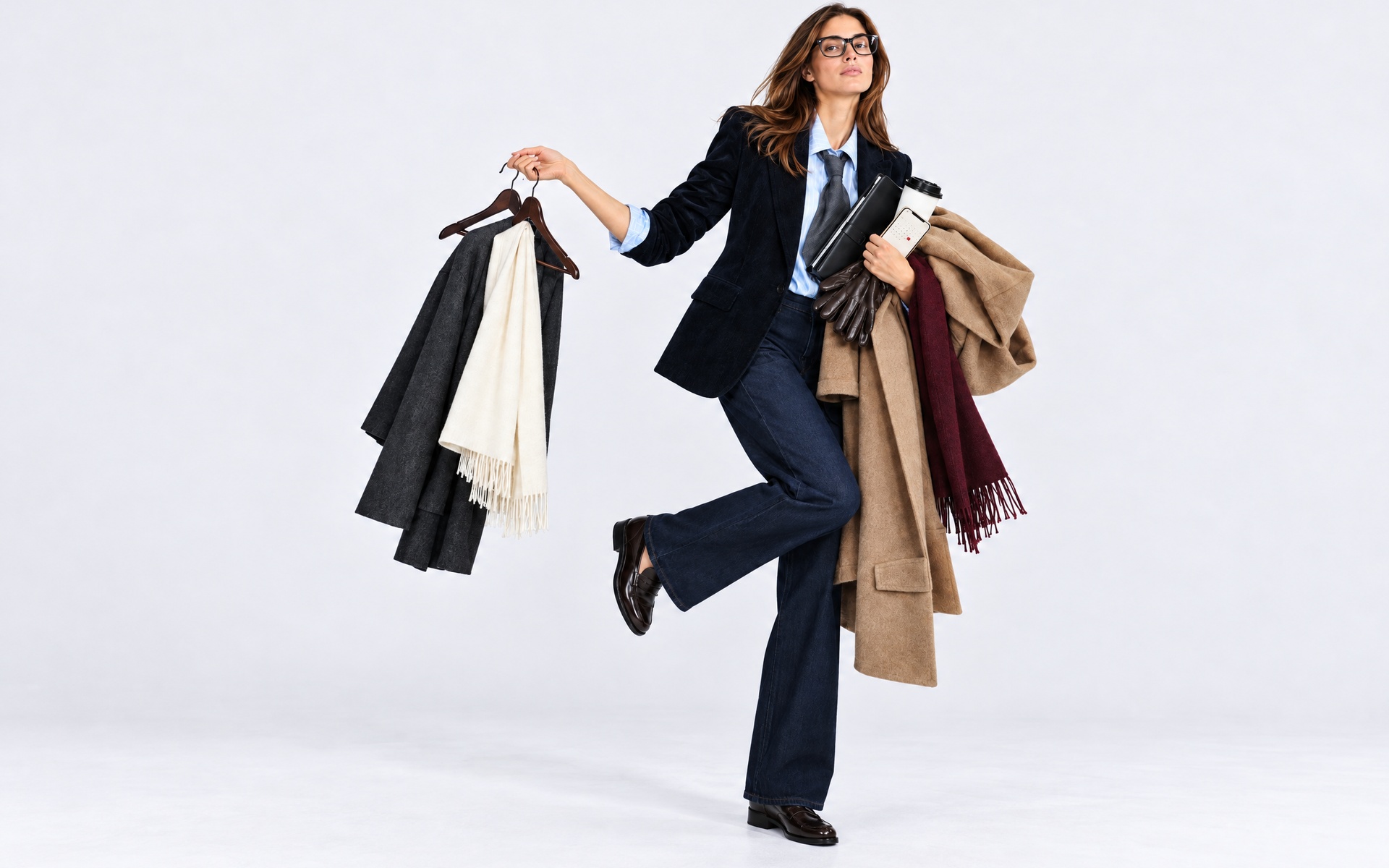
Winter layering doesn't have to mean several thick pieces stacked on top of each other. Thin layers work far better, each with its own job: a blouse or shirt, a light jumper or turtleneck, a jacket, and, if needed, outerwear. This approach lets you adapt to changing temperatures without losing a clean silhouette.
Pay particular attention to how the fabrics combine and how everything fits. If you plan to wear knitwear under a jacket, the pieces should not add bulk or disrupt the line of the garment. A thin, smooth-surfaced jumper or a vest under a jacket often turns out to be a good solution: they add warmth without overloading the outfit.
There is one more detail that is easy to underestimate: layering has to be checked together with your outerwear. A jacket that fits perfectly on its own can feel uncomfortable under a coat if the sleeves or shoulder area don't leave enough room. So it is best to do the final fitting in the full outfit — exactly as you plan to head to the event.


Outerwear and shoes: extending the business silhouette
Outerwear often shapes the first impression of an outfit before you even walk into the conference hall. So choose it not only for the temperature, but also with the proportions of your suit in mind. A structured wool coat supports the clean silhouette of a jacket, a looser cut lets you comfortably wear several layers underneath, and a minimalist sheepskin coat can be a modern alternative to the classic coat.
If you prefer a puffer jacket, look at its length, volume, and construction. A model with a defined shoulder line or a restrained silhouette is easier to pair with a business outfit than an overly sporty one. It matters that outerwear does not crush the jacket or restrict movement, especially if you will be getting around the city a lot.
Shoes should suit not only your style but also your route. For the trip in freezing weather, leather boots or ankle boots on a stable sole work well, while for time indoors you can choose loafers, pumps, or another pair that fits the format of the event. If you plan to change shoes, make sure the spare pair doesn't create extra logistical hassle and goes with all the outfits you have planned.
If the conference takes place in another city and involves several days of a packed program, it is worth planning in advance how your pieces combine. We covered the principles of such a wardrobe in more detail in "Business Trip Wardrobe: How to Dress for Several Days in a Row with One Suitcase"


Accessories, details, and an outfit for speaking
In a business outfit, accessories don't have to be unnoticeable, but it is important that they don't distract from the overall impression. Minimalist earrings, a watch, a belt, a structured bag, or a silk scarf can add personality to an outfit. In winter, it is especially interesting to work with textures: smooth leather, matte metal, dense knitwear, and wool fabrics create expressive combinations even in a restrained palette.
If you will be speaking on stage or taking part in a panel discussion, there are a few more nuances to consider. Clothes should look good not only in person but also on camera. A small high-contrast print can sometimes create an unwanted visual effect on video, and shiny surfaces can reflect stage lighting. It is better to choose expressive solid colors, moderate textures, and jewelry that won't interfere with the microphone.
Think through the construction of your outfit as well: if a lavalier microphone will be used, the collar, lapels, or neckline area should allow you to attach it comfortably. And for an active talk, freedom of movement and a comfortable fit matter — during a presentation, your clothes shouldn't demand constant attention.


Frequently asked questions
Which prints are best to choose if you will be speaking on camera?
The easiest option is solid-color fabrics or large, not overly contrasting patterns. A small check, a thin stripe, or a complex geometric print can sometimes create a flickering effect on video. If your talk will be recorded, it is better to test the outfit on camera beforehand.
Is a knit suit appropriate at a business forum?
It depends on the format of the event and the outfit itself. A knit suit with a clean shape, quality texture, and neat fit can be appropriate for Business Casual. For a more formal conference, it is better to choose a suit in suiting fabric or to add a structured jacket to the knitwear.
How should you dress if a business dinner is planned after the conference?
You don't have to change your whole outfit. You can choose a suit that looks right both during the day and in the evening, and after the program ends change just a few details: add more expressive jewelry, swap your shoes or blouse. It is important to find out in advance whether the dinner has its own dress code.
Can you combine different shades of suit and outerwear?
Yes, and it is often more interesting than matching everything tone on tone. For example, a navy suit looks good with a charcoal or caramel coat, while a grey outfit can be complemented by outerwear in a deep burgundy shade. The main thing is to keep the colors harmonious and consider the overall formality of the outfit.
Can you wear a turtleneck instead of a blouse under a business jacket?
Yes, but you need to consider the level of formality of the event. A thin solid-color turtleneck in smooth knit can be a good addition to a suit, especially in the cold season. For a more formal setting, choose minimalist cuts without active decor or excess volume.


When a business suit becomes a statement
Fashion history has proved more than once that business clothing can be far more interesting than a set of established rules. From Schiaparelli's bold experiments to modern takes on the classic suit, its form changes along with professional culture, but it keeps the ability to express individuality.
That is where the particular strength of a well-considered business style lies: it sets a visual frame but leaves room for your own interpretation. After all, a suit doesn't add weight to your words — it helps them be heard.