

There are sweaters that, five minutes before you leave the house, turn an outfit into a homey one. And there are equally soft and warm ones that bring in an urban rhythm, a pulled-together feel, even a touch of strictness.
And it isn't necessarily about the quality of the yarn, the composition, or the price of the piece.
Knitwear depends heavily on context. The same sweater can look completely different depending on what surrounds it, what shape the whole silhouette has, where the shoulder line falls, and how relaxed the outfit is overall.
So the question isn't how to make a sweater look more expensive. It's far more interesting to understand why knitwear sometimes reads as part of a considered style, and sometimes as clothing you simply stay home in.


From Military Uniform to Chanel
Knitwear has a remarkable history. And it is much less about "coziness" than we tend to think today.
The cardigan, for example, took its name from James Brudenell, the 7th Earl of Cardigan, a British military officer of the 19th century. For a long time, knitted clothing was linked with sport, work, and an active way of life: it was valued for warmth, elasticity, and freedom of movement.
The sweater, too, began far from the "sofa". In the late 19th and early 20th centuries, knitwear entered the sports wardrobe in a big way — for golf, tennis, rowing, and cycling. By the 1920s, the sweater had become a fully fledged fashion piece.
And then Gabrielle Chanel appeared in this story.
She was one of the first to turn knitwear from a functional fabric into a real part of the modern woman's city wardrobe. In the early 20th century, Chanel worked with jersey — a material previously associated mainly with men's underwear and sportswear. Her knitted pieces gave women what clothing of the time often did not: freedom of movement, simplicity, and an ease that was new for its era.
In other words, one of the most important transformations of knitwear happened not when it became a symbol of home comfort. Quite the opposite — when it stepped beyond function and became part of style.
It is worth remembering today. A sweater isn't obliged to look relaxed just because it is soft.


Balance Softness with Structure
This is where the practical part begins.
If an entire outfit is built from pieces that are equally soft, fluid, and loose, it easily takes on a homey tone. A big sweater with soft wide trousers and a roomy bag is a perfectly good formula for a day off. But for a city outfit, you often want a different feeling.
Then knitwear needs contrast.
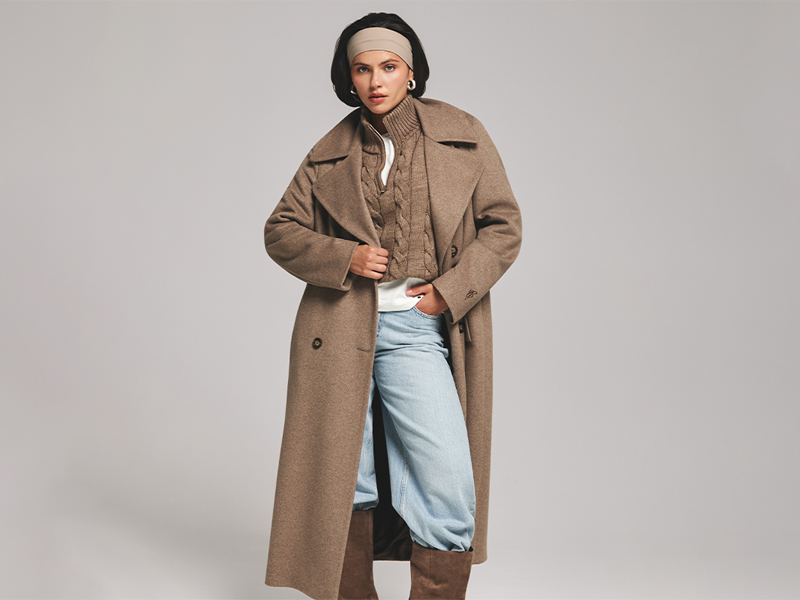
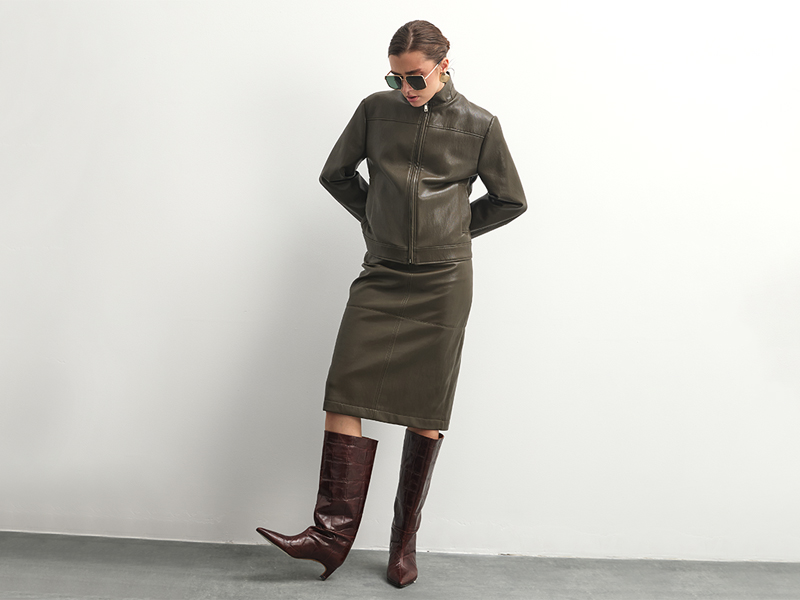
Straight tailored trousers can balance a voluminous sweater, a jacket can add a crisp shoulder line, a leather belt can define the waist, and a smooth skirt can bring a different texture next to the knit. A structured bag or shoes with a distinct shape also change how an outfit is perceived.
You don't need to use everything at once. It is enough for a soft piece to have something of the opposite character beside it.
Then the knitwear stays comfortable, but it stops defining the whole outfit.


A Cardigan Can Be a Jacket. Almost
The cardigan is often underestimated, because we are used to seeing it as an in-between layer: something to throw over a T-shirt when it gets chilly.
But a dense cardigan that holds its shape can work far more interestingly.
Partly buttoned, it changes the line of the neckline. Worn over a shirt, it creates a composition with the collar and cuffs. Left open, it forms a vertical line. Over a dress, it can replace a light jacket, and under a coat, it becomes a middle layer.
It works especially well when the cardigan doesn't try to look like a jacket but performs a similar function: it pulls the outfit together around itself.
Density matters here. A thin, fluid cardigan behaves like a soft first layer. A denser one, with a defined shoulder or a crisp placket, can already be a standalone part of the silhouette.
So when choosing a cardigan, it is worth looking at more than color. Ask yourself: does it create shape, or does it simply add warmth?
Both are needed. They are simply different roles.


Good Oversize Has Its Limits, Too
A loose sweater doesn't have to hug the figure to look put together.
But oversize is still a construction, not the absence of one.
Look at the shoulder: where does it end? How does the sleeve fall? Is there extra volume under the arms? What happens to the hem when you move?
These details are especially noticeable in knitwear, because it sits in direct contact with the body and responds to it quickly.
There is one more thing that is rarely mentioned in articles about the "expensive look": the condition of the knitwear matters more than its decoration.
A stretched-out neckline, baggy elbows, a misshapen hem, or visible pilling change how a piece is perceived faster than the absence of cashmere in the composition.
That is why care here is not a household detail, but part of style.


Texture Shouldn't Compete with Itself
A dense, chunky knit already has plenty of character. It doesn't necessarily need another active texture, a busy print, and heavy jewelry.
And the other way round: a smooth, fine-gauge jumper can be a good backdrop for a textured skirt, a statement necklace, or a more complex jacket.
A simple principle works here: the more expressive the texture of the knitwear, the calmer the pieces around it can be.
But that doesn't mean textures can't be mixed. Quite the opposite. Wool knit with leather, knitwear with smooth silk, a soft cardigan with heavy denim — these are exactly the material pairings that often make an outfit more interesting.
The point isn't for everything to be equally restrained. It's for every texture to have its own place in the composition.


"Expensive" Doesn't Mean "Dressy"
It's tempting to think that a polished outfit must have jewelry, a statement bag, complicated shoes, and something else "interesting".
But knitwear often works better when nothing stops it from being everyday.
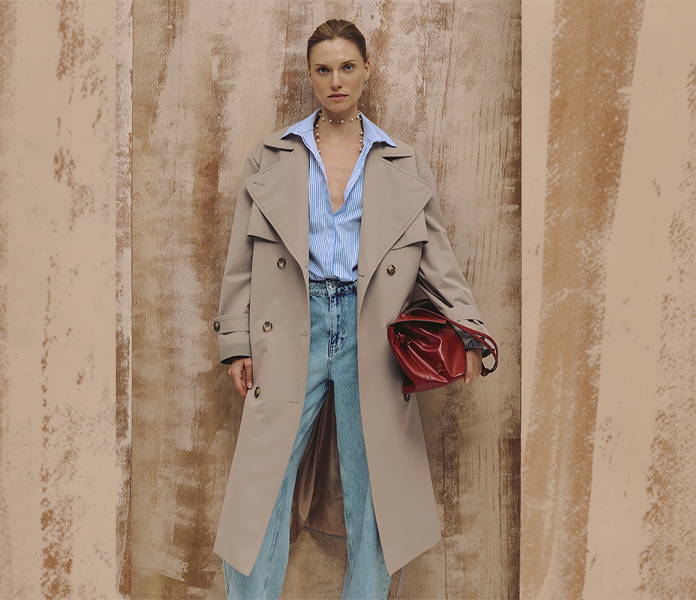
A simple sweater with straight trousers, a quality coat, and one expressive pair of shoes can look more convincing than the same sweater surrounded by five decorative accents.
Looking expensive isn't necessarily the same as looking festive. It can be very simple clothing, with clear proportions, clean lines, good texture, and no sense that every piece is trying to make a statement at once.
Knitwear shows this difference especially well.


Try Changing Not the Sweater, but What Surrounds It
Here is a simple experiment you can do with the pieces already in your wardrobe.
Take your favorite sweater and build three different outfits around it. Don't change the sweater itself — change only what is next to it.
In the first, keep a soft bottom half and relaxed shoes.
In the second, add straight trousers or a skirt, a structured bag, and a coat with a crisp shoulder line.
In the third, try a different texture — leather, a smooth fabric, denim — and change the shoes.
See how the same piece changes character along with its context.
This is one of the most useful styling skills: seeing not just the piece, but its role in the whole outfit.
In the Natali Bolgar collection, knitwear fits easily into exactly this kind of system. A sweater or cardigan can remain the soft foundation of an outfit, while tailored pieces, shirts, skirts, trousers, and outerwear work alongside it. Depending on the pairing, its role changes too — from a first warm layer to a full-fledged accent.


And Then It's No Longer About the Sweater
You can know dozens of styling tricks and still not understand every morning why the pieces in your wardrobe seem good on their own but don't work together.
Or you can gradually learn to see something else: not a single sweater, cardigan, or jacket, but the connections between them.
This is where personal style begins — not with knowing every trend, but with understanding which pieces, shapes, and textures work naturally in your own system.
We wrote about this in the article "How to Find Your Personal Style If No Trend Appeals to You".
And perhaps this is the main strength of knitwear.
It can be very simple, but once its role is defined correctly, the simplicity no longer looks accidental.
Style begins where even the coziest piece has its place in the outfit.