There's a curious paradox to adult life. The closet can be packed to the brim. And yet, every single morning, the same question comes up: "What am I going to wear?"
Especially on the days when work, meetings, kids, calls, the city, and deadlines are all waiting — and standing in front of the mirror for twenty minutes is the last thing you want to spend energy on.
Not because there aren't enough clothes, but because none of them work together. This is exactly where the idea of a capsule wardrobe comes in. And no — it isn't about owning ten identical beige pieces or living by strict style rules.
It's more about turning your wardrobe into an ally, rather than another morning puzzle.


What is a capsule wardrobe — and why is everyone talking about it?
In short, a capsule is a wardrobe where the pieces mix and match effortlessly.
A small but carefully considered set that lets you build dozens of looks for different scenarios in life: work, downtime, travel, dinner with friends, or just an ordinary Tuesday.
The same trousers can be worn with a shirt to the office, with a t-shirt for a day around town, and in the evening with a jacket and jewelry — for an entirely different mood.
"A capsule is a set of pieces that combine easily with one another. Its main purpose is to simplify getting dressed every day and make the wardrobe more functional," explains Natali Bolgar stylist Anastasia.
And this is one of those cases where the idea sounds almost too simple to work. But it does.


In fact, this is far from a new invention
Although the phrase "capsule wardrobe" sounds today like something out of Pinterest or TikTok, the idea itself dates back to the 1970s.
It's credited to Susie Faux, owner of a London boutique, who put forward what was then an almost revolutionary thought: a woman doesn't need a large number of pieces if they genuinely work together.
And in 1985, designer Donna Karan introduced her legendary concept, Seven Easy Pieces — seven items that could be combined into dozens of outfits.
Honestly, it sounds remarkably current. Especially now, when there's less time than ever.


Step 1. Look at your real life
Not at Pinterest. Not at the wardrobe of your dreams. And not even at the woman you feel you "should" be. At the real you.
"Before buying new pieces, it's important to understand where you spend most of your time, what dress code applies, and which looks you need most often," advises Anastasia.
If 80% of your life is work, the city, meetings, and a fast pace, with evening outings happening only a couple of times a month, then a good jacket right now might matter more than one more "special" dress.
A capsule doesn't start with a shopping list. It starts with honesty.


Step 2. Define your color system
This is exactly where a wardrobe stops being chaotic. And starts working. The simplest rule: choose 2–3 base colors and 1–2 accent colors.
"When pieces follow a single color logic, combining them becomes far easier," Anastasia explains.
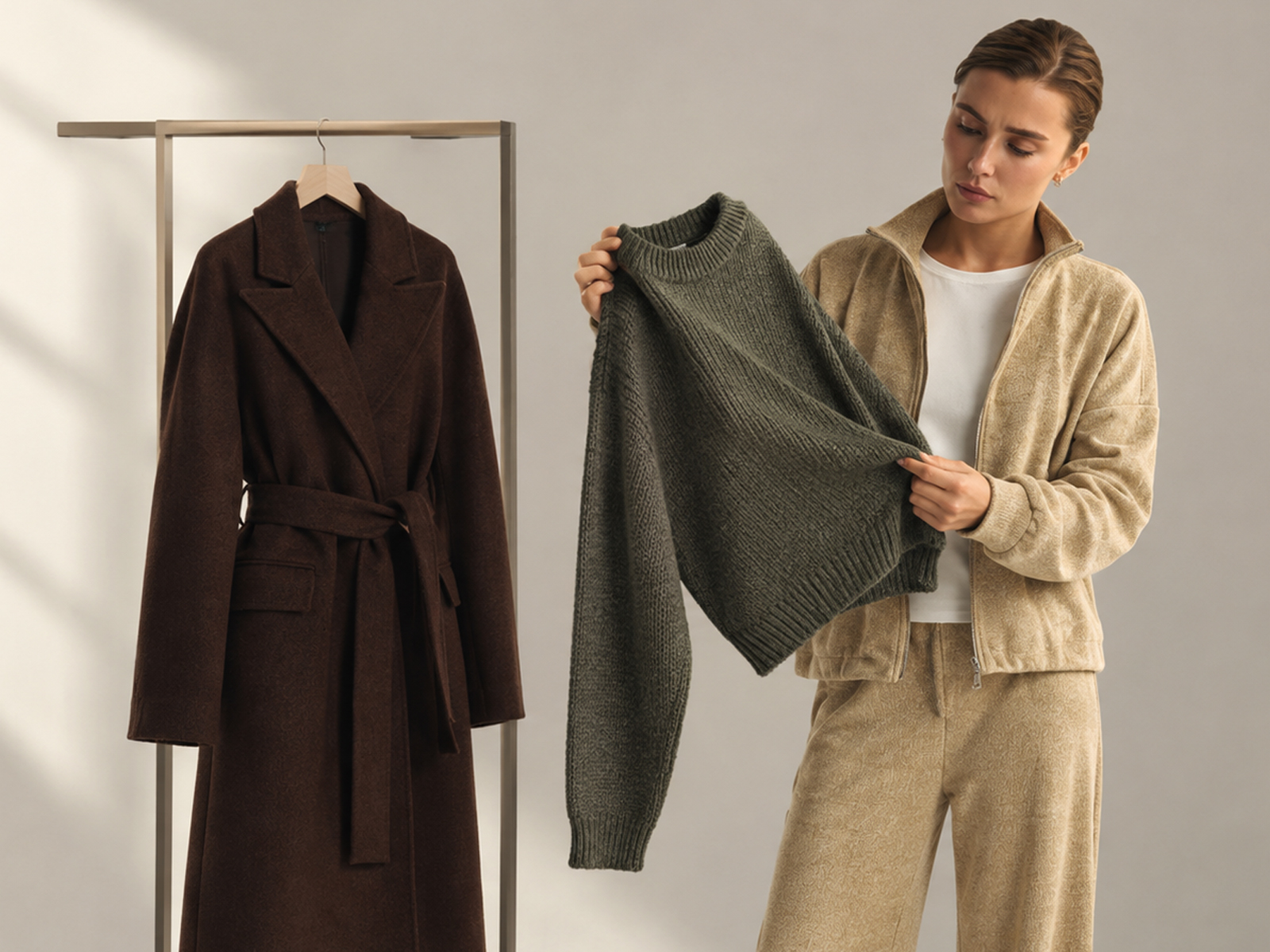
For instance, navy, milky white, and gray could form the base. Or chocolate, beige, and khaki. The accent could be a bag, a shirt, jewelry, or shoes.
This is exactly why a good base rarely goes out of style: it never conflicts with itself.


Step 3. Build the foundation of your wardrobe
This is usually where the magic begins. Because a capsule isn't about owning the fewest possible pieces. It's about owning the right ones.
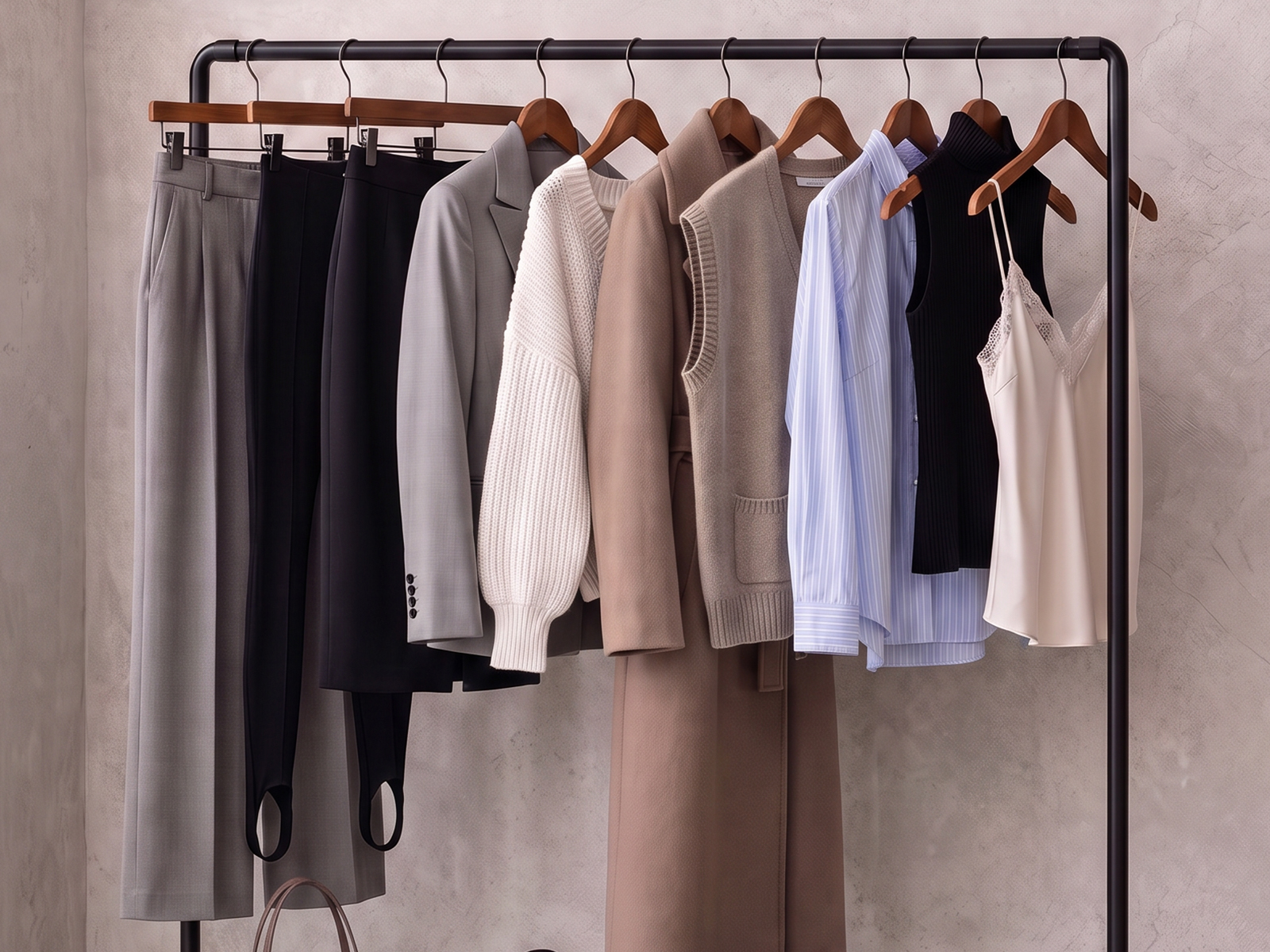
The foundation can include:
- a jacket;
- a shirt;
- t-shirts;
- denim;
- classic trousers;
- skirts;
- dresses;
- an outer layer;
- versatile shoes.
"The foundation of a wardrobe is made up of the pieces you wear regularly. They should fit well, combine easily, and suit your lifestyle," says Anastasia.
Sometimes one well-tailored jacket does more for you than five impulse purchases.


Step 4. Add character
One of the biggest mistakes is assuming a capsule wardrobe has to be boring. It doesn't. Because a capsule without personality is just a neatly assembled list.
It's the accent pieces that bring a wardrobe to life: a colorful top, a printed blouse, an interesting bag, jewelry, or shoes that suddenly pull an entire look together.
"Accent pieces keep a wardrobe from looking repetitive. They're what adds mood and style," says Anastasia.
Sometimes one strong accent is all it takes for a look to feel completely different.


Step 5. Test the combinations
There's a simple test stylists love above all others. Every piece in a capsule should combine with at least three others.
"This is the core principle of an effective capsule. If a piece only works in one outfit, it's worth asking yourself how much you really need it," Anastasia explains.
Harsh? A little, but very practical.


Step 6. Let go of the excess
This is probably the hardest stage. Especially when a wardrobe already has a history of its own. But a good capsule is rarely built around pieces kept "just in case."
Keep what:
- fits properly;
- suits your lifestyle;
- you genuinely want to wear.
Everything else often creates more noise than value.


Why a capsule wardrobe really does make life easier
No, it's not that you'll suddenly turn into a minimalist. Or that you'll stop loving shopping. It's simply that decision fatigue disappears.
Fewer impulsive choices mean less morning panic. More ready-made combinations mean a stronger sense of order.
At Natali Bolgar, the idea of a capsule has always been treated more as sound wardrobe logic: when a jacket works with both denim and a dress, when a shirt isn't reserved "for the office" alone, and pieces move easily from one life scenario to the next.
This is exactly how a wardrobe starts working for a woman. Not the other way around.
A capsule wardrobe isn't about restriction. It isn't even about discipline — it's closer to peace of mind. Because a good wardrobe rarely complicates life. Usually, it makes life easier.